Open Sky Live
Date: Thursday September 3
Time: 6:00 PM to 9:00 PM
Location: Elora Centre for the Arts (75 Melville St, Elora)

Housing is foundational to complete, inclusive, and resilient communities. It shapes who can live in a community, who can remain in it over time, and whether residents are able to access the services, supports, employment opportunities, and social connections that contribute to quality of life and community well-being.
In Centre Wellington, housing pressures are becoming increasingly prevalent across the community. Rising housing costs, limited rental availability, changing household needs, demographic shifts, and a constrained range of housing options are affecting residents at different stages of life and across a broad range of incomes and household circumstances. While these pressures are being experienced across Ontario and throughout many rural and small urban municipalities, housing actions must be locally responsive to the unique context, character, growth patterns, and housing stock of Centre Wellington.
The Township is developing a Housing Action Plan to guide a coordinated and targeted municipal response to these challenges. The Housing Action Plan will build upon the Township’s Housing Needs Assessment and will identify practical and implementable actions that may support a broader range of housing options, improve housing choice, and strengthen the Township’s ability to respond to evolving housing needs.
This work is not intended to approach housing as a singular issue with a singular solution. Housing systems are inherently interconnected and are shaped by planning policy, land supply, infrastructure, market conditions, construction costs, demographic change, funding programs, legislation, economic conditions, and the actions of multiple public, private, and community-sector partners. Meaningful municipal housing work requires both a strong understanding of local conditions and a recognition of the broader systems that shape how housing is planned, delivered, accessed, and experienced.
The Housing Action Plan will help the Township better understand where municipal influence is strongest, which partnerships are necessary, and how local policies and implementation mechanisms can support more positive housing outcomes within the community.
Housing influences how communities grow, thrive, and care for their residents. When housing options are affordable, diverse, and accessible, young people can remain in the community as they enter the workforce, older adults can age in place with dignity, families can find homes that adapt to their evolving needs, and local employers are better positioned to attract and retain workers. In turn, residents benefit from a vibrant, inclusive, and resilient social and economic community.
The Township’s Housing Needs Assessment identified several trends and pressures that reinforce the need for a more coordinated local housing response, including:
These trends are important because healthy communities depend on a range of housing types, affordability thresholds, and sustained supply. Currently, more than 1 in 6 households in Centre Wellington cannot afford their housing. A resilient housing system supports everyone, including people across different incomes, household sizes, cultures, life stages, abilities, and circumstances.
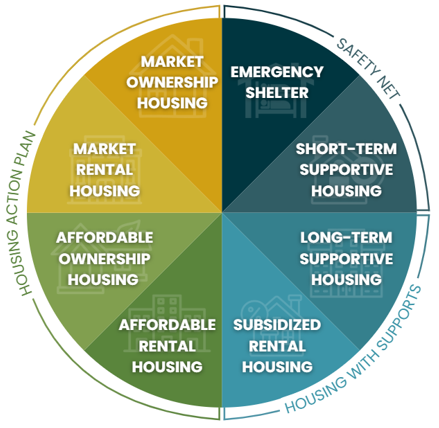
The Township uses the Housing Wheelhouse framework, originally developed by the City of Kelowna and adapted for local application, to reflect the evolving nature of housing needs throughout different stages of life. Unlike the traditional linear housing continuum, the Housing Wheelhouse acknowledges that housing pathways are non-linear and should align with a community’s socioeconomic and demographic diversity. It moves away from the assumption that all households have the goal of market home ownership, recognizing instead that housing needs may change in response to shifting personal, economic, and health circumstances.
The model reframes transitional housing instead as short-term supportive housing. Short-term supportive housing reflects the role of time limited accommodation paired with services that provide stability during periods of transition. Long-term supportive housing recognizes that some individuals may require ongoing or indefinite supports to maintain housing security. For some individuals, including those requiring assisted living or residential care, long-term supportive housing may represent the most appropriate and stable form of accommodation rather than a transitional step towards market home ownership.
By adopting the Housing Wheelhouse model, the Township affirms a more inclusive and realistic understanding of community housing needs. The framework reinforces the importance of planning for a diverse and balanced housing mix that accommodates varying levels of affordability, accessibility, and support across the lifespan.
Within this framework, the Housing Action Plan will primarily focus on areas where the Township has the greatest opportunity to influence outcomes through municipal planning, policy, regulatory, financial, and incentivization tools, particularly within the affordable, below-market, and market rental and ownership aspects of the housing system.
Other components of the housing system, including homelessness response, emergency shelter, short-term and long-term supportive housing, and deeply affordable housing delivery, remain critically important; however, these areas are the responsibility of Wellington County in its role as Consolidated Municipal Service Manager.
Affordable housing is often discussed as though it represents a singular form of housing; however, affordability exists across a spectrum and may look different depending on individual household income, tenure, and housing needs.
Generally, affordable housing refers to housing that can be accessed without households spending more than 30% of their gross income on shelter costs. Affordable housing may include both rental and ownership options and may occur within both market and non-market contexts.
In June 2024, the Provincial government introduced a Provincial Bulletin, which provides affordable home ownership or affordable rental prices for each municipality across Ontario and is updated annually.
For Centre Wellington, an affordable home ownership price is set at or below $461,800. The Province also set affordable rents at or below the following:
Alleviating housing pressures and addressing the housing crisis requires coordinated and collaborative efforts across all levels of government, non-profit housing providers, and the development industry. In this context, the Township plays an important role in shaping the right conditions under which housing is delivered. The Township cannot directly control broader market forces or private development and investment decisions. The Township also does not directly deliver social housing; Wellington County is the Consolidated Municipal Service Manager responsible for administering social and affordable housing programs in Centre Wellington. The Township’s role includes:
The Housing Action Plan will help clarify where the Township can lead directly, support and facilitate housing outcomes, and build collaborative and partnership-based approaches.
While it is unknown what the outcomes and recommendations arising from the Housing Action Plan will be, it may explore:
The scope of the project will continue to evolve as technical work, analysis, and future engagement activities are undertaken.
Housing conversations are often complex because they involve balancing growth, affordability, infrastructure, neighbourhood character, environmental sustainability, economic development, and community well-being simultaneously.
The Housing Action Plan represents an opportunity to approach these conversations thoughtfully, collaboratively, and proactively within the Township of Centre Wellington’s local context.
This page will continue to be updated as the project progresses and as additional information, project materials, and future opportunities for participation become available.
Project staff will "pop-up" at the locations below to speak with community members about the Housing Action Plan.
Date: Thursday September 3
Time: 6:00 PM to 9:00 PM
Location: Elora Centre for the Arts (75 Melville St, Elora)
Date: Saturday, September 12, 2026
Time: 10:00 AM to 12:00 PM
Location: Downtown Fergus
Date: Saturday, September 19, 2026
Time: 9:00 AM to 1:00 PM
Location: Bissell Park (127 East Mill Street, Elora)
Date: Sunday, September 20, 2026
Time: 9:00 am - 1:00 pm.
Location: CW Community Sportsplex, 550 Belsyde Ave, Fergus
Date: Wednesday, September 23, 2026
Time: 11:00 AM to 12:00 PM
Location: Victoria Park Seniors Centre (150 Albert Street W, Fergus)
Date: September 30
TIme: 12 PM to 2:30 PM
Location: Centre Wellington Food Bank (105 Queen Street West, Unit 12, Fergus)
Date: Thursday, October 1, 2026
Time: 6:00 PM to 8:00 PM
Location: Centre Wellington Community Sportsplex
Date: Wednesday, October 7, 2026
Time: 11:00 AM to 12:00 PM
Location: Victoria Park Seniors Centre (150 Albert Street W, Fergus)
Date: Saturday, October 10, 2026
Time: 11:00 AM to 3:00 PM
Location: Wellington County Museum & Archives (0536 Wellington Rd 18, Fergus)

Have questions or want to learn more about a project, contact us below:
| Phone | 5198469691 |
|---|---|
| In writing | Township of Centre Wellington |